How to Choose an Online University in India: 10 Things to Check
Online education has become an increasingly popular option for students who want to pursue higher education with greater flexibility. Students can explore undergraduate and postgraduate programs without relocating to another city or attending a traditional campus every day.
However, choosing the right online university in India requires more than comparing course fees or looking at advertisements. Students should carefully check the institution, specific program recognition or entitlement status, curriculum, examination process, learning platform, student support, and career services before taking admission.
What Is an Online University?
In India, the term "online university" is used informally. Legally, it refers to a recognized higher education institution entitled to deliver specific degree programs through online digital platforms.
Depending on the university and program, students receive access to:
- Live online interactive classes & recorded video lectures
- Digital study materials, e-libraries, and notes
- Learning Management Systems (LMS) with mobile app access
- Online assignment submission & continuous digital assessments
- Virtual doubt-solving forums & academic counselling
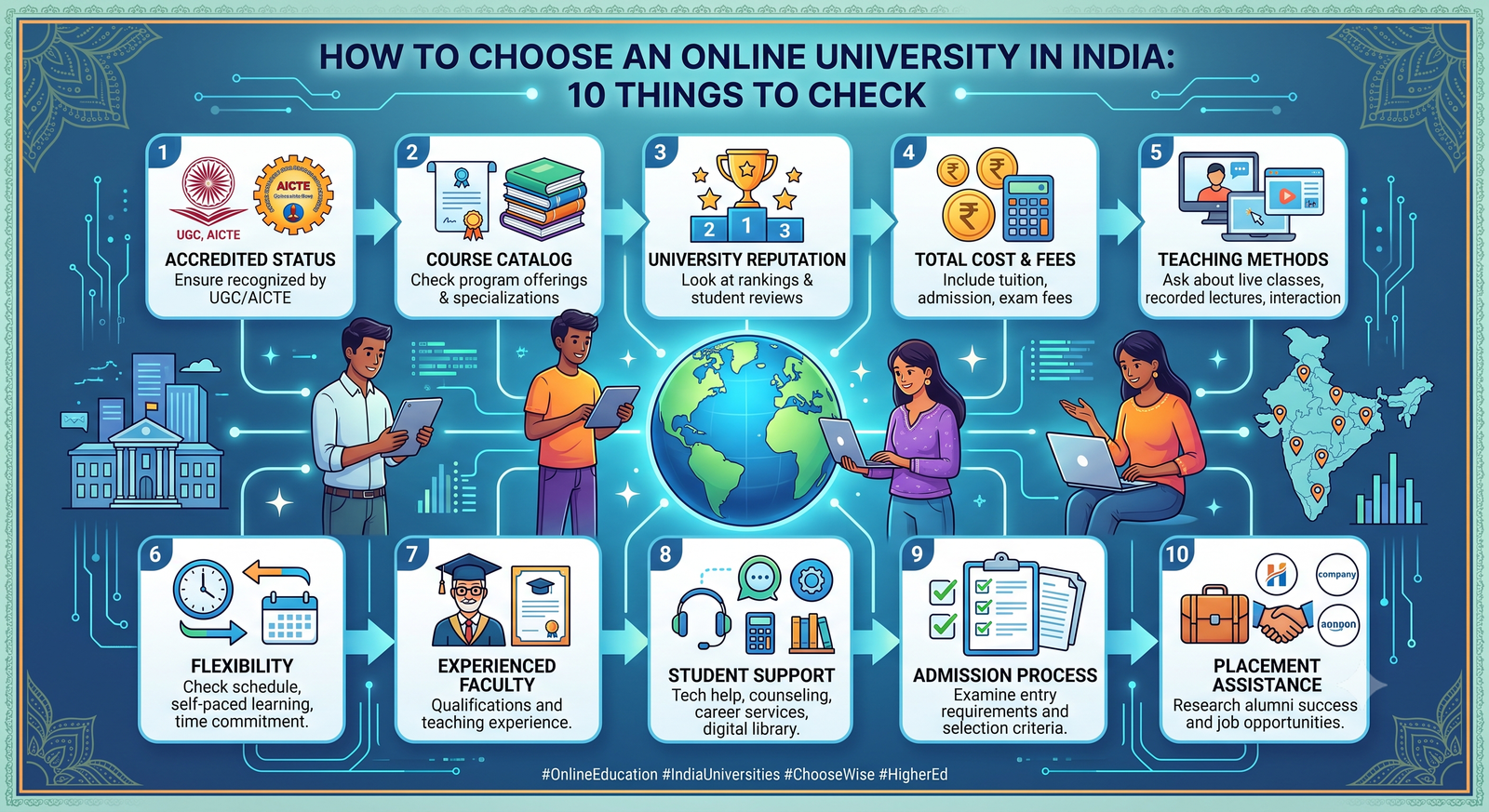
10 Things to Check Before Choosing an Online University in India
1. Check UGC-DEB Recognition and Online Entitlement
This is the single most critical step. For online and Open and Distance Learning (ODL) programs, students must check the official regulatory records provided by the UGC Distance Education Bureau (UGC-DEB).
Regulatory Warning: Do not rely on social media ads, admission agent claims, or old brochures. Entitlement is granted per university, per program, and for specific academic sessions. Verify the current academic session status on official UGC portals before paying fees.
2. Check Whether Your Specific Course Is Available Online
Never assume that because a university offers an online B.Com or MBA, their BCA, MCA, or M.Com is also entitled online. Certain professional or technical fields have specific statutory restrictions. Check if your exact degree title and specialization are permitted for online delivery.
3. Check Eligibility Requirements
Eligibility criteria differ between universities and programs:
- Undergraduate (UG): Generally requires 10+2 from a recognized board (some programs like BCA may specify mathematics or computer science requirements).
- Postgraduate (PG): Requires an accredited bachelor's degree with minimum percentage thresholds (typically 50% for General, 45% for Reserved categories).
4. Compare the Curriculum and Syllabus
Download and review the latest semester-wise syllabus. A quality online program should include modern tools and industry-aligned subjects:
- Tech Programs (BCA/MCA): Look for Python, Cloud Computing, Database Systems, Web Development, and AI fundamentals.
- Management (BBA/MBA): Look for Business Analytics, Digital Marketing, Fintech, and case-study-driven modules.
5. Check Faculty and Academic Support
A good online program should never leave you studying in isolation. Find out:
- Are classes conducted live by core faculty, or are they only pre-recorded videos?
- What is the turnaround time for resolving student tickets and academic queries?
- Are periodic live doubt-clearing sessions organized before exams?
6. Understand the Online Learning Platform (LMS)
The Learning Management System (LMS) will be your daily digital classroom. Ensure the portal offers a responsive mobile interface, clear academic calendars, easy submission dashboards, and offline access to digital notes.
7. Check the Examination and Assessment Process
Every university handles examinations differently. Clarify the format beforehand:
Exam Checklist: Are term-end examinations conducted via online AI-proctored platforms from home, or do you have to travel to physical designated examination centers?
8. Compare the Complete Fee Structure
Instead of looking only at the semester tuition fee, calculate the total cost of education across the entire degree duration. Check for:
- Registration and one-time admission fees
- Semester examination fees and project submission fees
- Digital library, LMS, and physical book delivery charges (if applicable)
- EMI options, scholarship concessions, and refund/cancellation policies
9. Check Career and Placement Support
Distinguish between active placement assistance and vague marketing claims like "100% Guaranteed Jobs". Genuine online universities provide resume workshops, virtual job fairs, interview prep, and corporate tie-ups.
10. Check Student Reviews and Overall Reputation
Speak to alumni or search verified student feedback regarding LMS stability, mark sheet dispatch timelines, internal grading transparency, and administrative responsiveness.
List of Private Universities to Research for Online & Distance Programs
Students exploring higher education options can research these private universities, keeping in mind that course availability and regulatory status vary by academic session:
1. Subharti University
Known for distance and higher education programs. Check course-specific entitlement for current sessions on official portals.
2. Mangalayatan University
Offers diverse undergraduate and postgraduate programs. Review current LMS infrastructure and fee structures before applying.
3. Dr. Preeti Global University
Private institution providing higher education courses. Verify program approval and admission eligibility criteria.
4. Bir Tikendrajit University
Offers varied academic streams. Confirm latest program delivery modes and regulatory notifications.
5. Guru Kashi University
Provides diverse professional programs. Check syllabus relevance, faculty support, and exam systems.
6. Matrix Skilltech University
Focuses on skill-oriented higher education. Compare curriculum, practical modules, and student support.
7. Asian International University
Offers multi-disciplinary degree options. Verify specific session recognition prior to admission.
8. NIILM University
Private university with options in management, commerce, and arts. Check course validity and examination patterns.
9. Sikkim Alpine University
Explore for higher education pathways. Review fees, student services, and latest statutory documentation.
How to Compare Universities Objectively
| Key Evaluation Factor | University A | University B | University C |
|---|---|---|---|
| UGC-DEB Specific Program Status | Verify | Verify | Verify |
| Comprehensive Fee (All Semesters) | Compare | Compare | Compare |
| Live Sessions + LMS Quality | Check | Check | Check |
| Examination Mode (Online / Center) | Check | Check | Check |
| Internship & Placement Assistance | Check | Check | Check |
| Cancellation & Refund Policy | Check | Check | Check |
Online University vs Traditional Campus: Key Differences
| Factor | Online University | Traditional University |
|---|---|---|
| Learning Delivery | Digital LMS (Live & Recorded) | Physical classrooms & lectures |
| Schedule Flexibility | High (Learn at your own pace) | Fixed daily timetables |
| Relocation & Travel | Zero commute / Zero hostel costs | Mandatory daily commute or hostel |
| Work & Study | Seamless for working professionals | Difficult alongside full-time jobs |
| Discipline Needed | High personal self-discipline | External institutional structure |
| Networking | Digital communities & LinkedIn | In-person peer & campus network |
Step-by-Step Online Admission Roadmap
- 1 Select Your Course: Align your choice with your career goals (e.g., BCA for Tech, BBA/MBA for Business).
- 2 Verify Program-Specific Approval: Check UGC-DEB notifications for the current academic session.
- 3 Evaluate Total Fees: Factor in examination and registration charges, not just tuition.
- 4 Prepare Digital Documents: Keep clear scanned copies of mark sheets, ID, photo, and certificates.
- 5 Submit University Application: Register via official admission portals.
- 6 Fee Payment & LMS Access: Complete official payment and log in to your student LMS dashboard.
Documents Required for Online Admission
Common Mistakes to Avoid
- Choosing Purely on Lowest Price: Extremely cheap courses often lack academic support, live classes, or recognized certifications.
- Assuming All Degrees Are Permitted Online: Regulatory bodies do not permit all technical or clinical courses online. Always verify entitlement.
- Ignoring Examination Format: Not checking whether exams are held online or require travelling to physical centers.
- Falling for "100% Guaranteed Job" Gimmicks: Career outcomes depend primarily on your practical skills, portfolio, and interview preparation.
How Gyan Institute (GIHS) Can Help
Navigating multiple universities, regulatory guidelines, and specializations can feel overwhelming. Gyan Institute of Higher Studies (GIHS) provides structured counselling to help students:
- Identify courses matching their career objectives and background
- Compare university accreditations, curriculum, and fee structures
- Understand admission criteria and documentation requirements
- Choose between online, distance, and regular learning pathways
Frequently Asked Questions
Yes. As per UGC regulations, online degrees earned from entitled higher education institutions hold equal academic value and equivalence to conventional degrees for government jobs, private corporate roles, and higher studies.
No. A university may be UGC-approved for regular on-campus education, but it must have specific UGC-DEB entitlement to offer that particular course in online mode for the relevant academic session.
Most modern online universities conduct exams online using AI-proctored systems that you can take from home. However, some universities or courses require visiting designated physical test centers. Always verify before admission.
Yes. An online bachelor's degree from a UGC-entitled university makes you eligible to apply for regular or online postgraduate programs and competitive examinations across India and abroad.
Speak with an Academic Advisor
Share your details and our counsellors will assist you with degree options, fees, and eligibility.