College Admission 2026: Documents, Eligibility and Application Process
Securing admission to the right college is one of the most critical turning points for students transitioning from school to higher education. With hundreds of universities, multi-disciplinary courses, emerging specializations, and evolving admission norms, figuring out where to start can easily feel overwhelming.
From choosing a course aligned with industry demand and verifying university accreditations to preparing mandatory certificates and tracking cutoffs, every step demands structured preparation. Planning early for College Admission 2026 ensures smooth application processing and eliminates avoidable last-minute errors.
Why College Admission Planning Matters
Your undergraduate degree sets the direction for your future career, internships, and higher study pathways. Structured planning enables you to:
- Shortlist relevant degree programs based on your academic strengths
- Compare institutions by fee structure, faculty credentials, and campus culture
- Organize necessary documentation well before deadlines
- Track national and university entrance examination cycles
- Identify merit-based and need-based scholarship options early
Step 1: Choose the Right Degree Course
Before researching campuses, get clear on the academic domain you want to pursue. Key undergraduate options after Class 12 include:
Commerce & Business
BBA & B.Com: Ideal for corporate leadership, finance, banking, business analytics, and marketing roles.
Technology & IT
BCA & B.Tech: Geared toward software development, cloud infrastructure, cybersecurity, and data science.
Science & Healthcare
B.Sc & B.Pharm: Best suited for clinical research, pharmaceutical production, analytics, and laboratory sciences.
Humanities & Media
BA, Journalism, Design: Leads into creative communications, digital content strategy, law, and civil services.
Step 2: Shortlist Reputed Universities
Evaluate institutions that offer recognized curricula and credible student support systems. Universities that students commonly research for 2026 admissions include:
- Manipal University
- Amity University
- Chandigarh University
- Lovely Professional University (LPU)
- UPES (University of Petroleum and Energy Studies)
- GLA University
- Uttaranchal University
- Shoolini University
- Vellore Institute of Technology (VIT)
- Sikkim Manipal University
- Sharda University
- Vivekananda Global University
Research Reminder: Avoid choosing a university based only on billboards or high-profile advertisements. Always verify the specific course syllabus, faculty experience, laboratory facilities, and real median placement reports.
Step 3: Check Minimum Eligibility Requirements
Eligibility criteria differ by course and institution. The general entry requirements after Class 12 include:
| Undergraduate Course | Standard Class 12 Stream | Typical Percentage / Subject Requirements |
|---|---|---|
| BBA | Any Stream (Commerce/Science/Arts) | 50% aggregate from a recognized board |
| B.Com / B.Com (Hons) | Commerce / Science | Passing Class 12 with Accounts/Maths (depending on university) |
| BCA | Any Stream / Science / Commerce | Class 12 pass; some universities require Mathematics or CS |
| B.Tech | Science (PCM) | Physics & Maths mandatory; entrance score (JEE/State CET) |
| BA / Journalism | Any Stream | Class 12 pass with English as a compulsory subject |
| B.Sc (Specialized) | Science (PCM / PCB) | 50% aggregate in relevant science subjects |
Step 4: Entrance Exams vs Merit-Based Admissions
Admissions generally follow one of two tracks:
- Entrance Examination Track: Required for top engineering, medical, law, and central university programs (e.g., JEE Main, CUET, NEET, CLAT, or university-specific tests). Track registration windows, syllabus patterns, and cutoff percentiles.
- Direct Merit Track: Based directly on your aggregate Class 12 board marks or internal qualifying rounds.
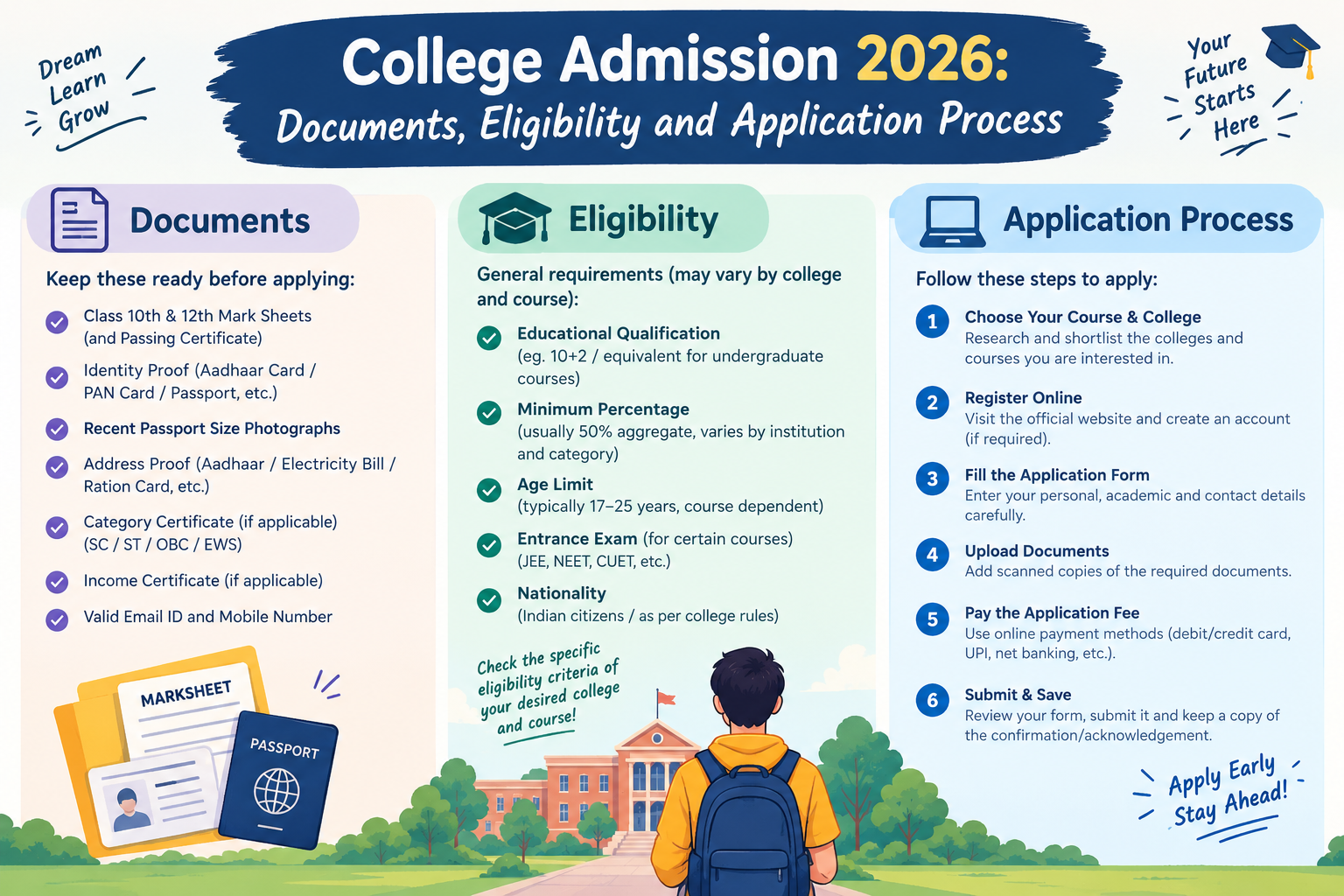
Step 5: Documents Required for College Admission 2026
Keep organized digital copies and multiple sets of self-attested photocopies ready before application deadlines:
Digital Document Best Practice: Save all scanned files in high resolution (under 200 KB to 500 KB as requested by portals) in PDF or JPEG format inside a secure cloud folder for quick access during registration.
The Step-by-Step College Application Roadmap
- 1 Complete the Official Online Application: Enter personal, residential, and academic marks accurately on the university portal.
- 2 Pay Application Processing Fees: Use verified payment gateways and save the transaction confirmation receipt immediately.
- 3 Track Merit Lists & Counselling Rounds: Check release dates for cutoffs or interview calls, and confirm your seat acceptance on time.
- 4 Undergo Document Verification: Present original certificates and verified copies to the admissions committee.
- 5 Confirm Enrollment with Fee Payment: Review the refund policy, complete the tuition installment, and save your admission slip.
Evaluating Scholarships and the Total Cost of Education
Do not evaluate college affordability based only on semester tuition. Calculate the comprehensive annual expense:
- Tuition, lab, and internal examination charges
- Hostel room rent, mess charges, and laundry fees
- Daily transportation and study material costs
Ask the admissions cell about merit scholarships based on Class 12 aggregate percentages, sports achievements, or defense quotas, along with renewal criteria for subsequent years.
Common Mistakes to Avoid During Admission 2026
- Choosing Purely on Peer Influence: Enrolling in a course simply because friends are doing it.
- Waiting for Final Deadlines: Rushing at the last minute often leads to server crashes and incomplete documentation.
- Ignoring Refund & Withdrawal Clauses: Failing to read UGC refund guidelines if you decide to cancel or change your seat.
- Believing "100% Placement" Slogans: Prioritizing verified internship networks and skill-building opportunities over vague marketing statistics.
Get Admission Guidance for 2026
Sorting through admission rules, cutoff variations, and degree paths can be challenging. =Gyan Institute of Higher Studies (GIHS) offers guidance to help students:
- Identify degree courses suited to their academic profile and long-term career goals
- Compare university accreditations, curriculum modernizations, and fee structures
- Understand application procedures, eligibility criteria, and documentation requirements
- Evaluate regular, distance, and online education options
Frequently Asked Questions
The essential documents are your Class 10 marksheet (for date of birth verification), Class 12 marksheet, transfer certificate (TC), migration certificate, valid government photo identity proof, and recent passport-size photographs.
No. While centralized programs and premier institutes require tests like CUET, JEE, or CLAT, many private and state universities offer direct admission based on Class 12 board merit.
Yes. Applying to 3 to 5 shortlisted institutions is recommended so you have solid backup options if cutoffs or fee requirements differ from your initial plans.
Most universities allow provisional admission based on your official online result printout or DigiLocker-verified marksheet, provided you submit the original certificate within their specified verification window.
Speak with an Academic Advisor
Share your details and our counsellors will assist you with degree options, fees, and eligibility.