How to Check if a University Is UGC Approved: A Complete Guide for Students (2026)
Choosing the right university is one of the most critical decisions in your academic life. Before paying admission fees or submitting your certificates, verifying whether the university is recognized by the University Grants Commission (UGC) is non-negotiable.
A degree from an accredited institution guarantees that your qualifications are legally valid for central and state government jobs, public-sector recruitments, corporate hiring, and higher studies abroad. Every year, thousands of students fall into the trap of unapproved or fake universities due to misleading marketing brochures and unchecked claims.
What Is UGC & Why Is Approval So Important?
The University Grants Commission (UGC) is the statutory body of the Government of India established under the UGC Act 1956. It is responsible for coordinating, determining, and maintaining the standards of university education in India. Under Section 22 of the UGC Act, only universities established under Central, State, or Provincial Acts—or institutions deemed to be universities—have the right to confer degrees.
Degree Validity
Ensures your bachelor's, master's, or doctoral degree is legally recognized across India and globally.
Government Job Eligibility
Essential for applying to UPSC, SSC, Banking, Defense, State PSCs, and public sector undertakings (PSUs).
Higher Education Access
Prerequisite for qualifying tests like UGC-NET, GATE, CAT, and admissions into global universities.
Corporate Credibility
Protects you during background verification (BGV) checks conducted by top multinational companies.
Step-by-Step Guide: How to Verify a University's UGC Status
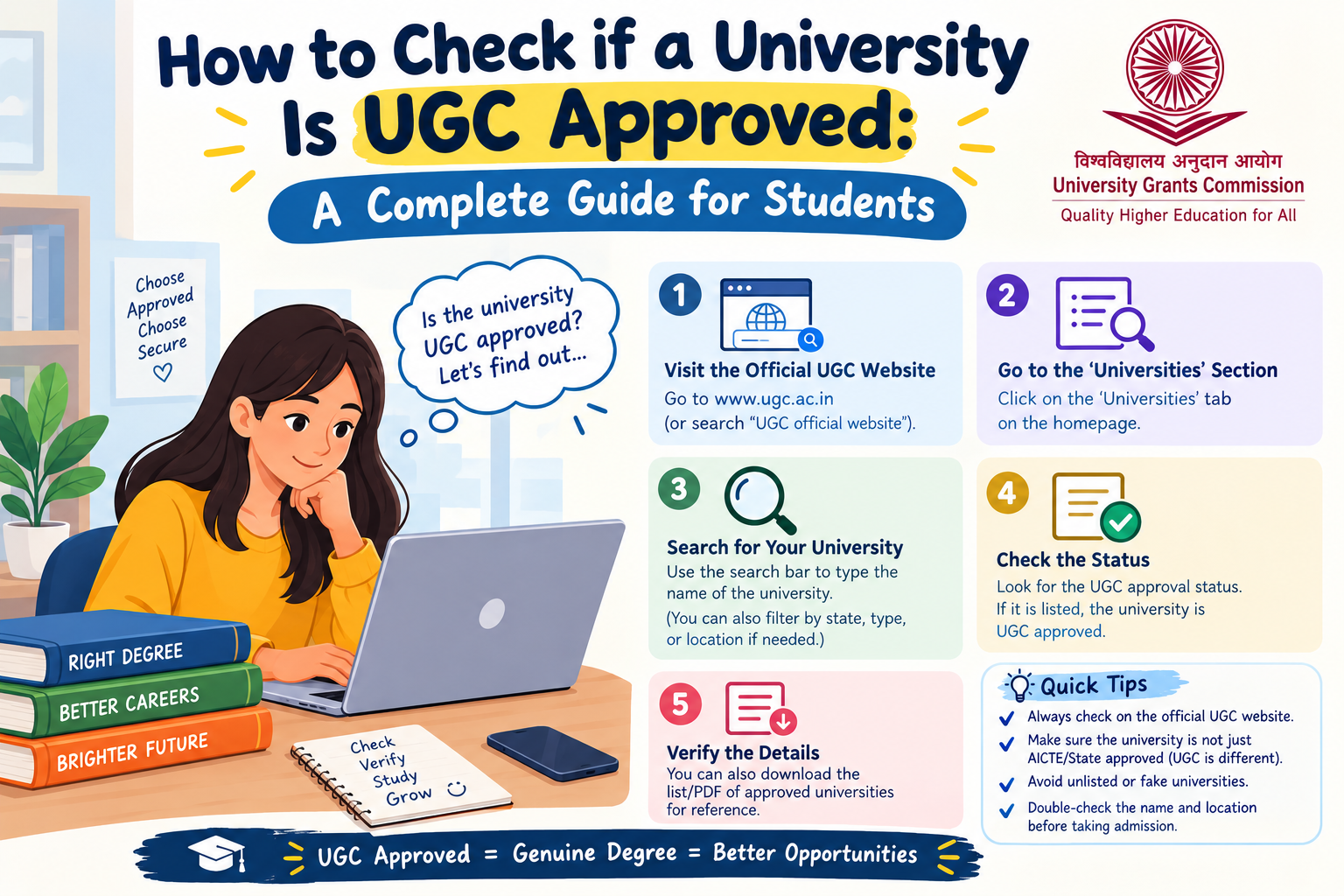
- 1 Visit the Official UGC Portal: Head directly to the official regulatory website (ugc.gov.in or deb.ugc.ac.in). Never rely on third-party admission aggregator blogs.
- 2 Navigate to the "Universities" Section: Under the main menu, look for Universities $\rightarrow$ Central / State / Private / Deemed Universities lists.
- 3 Search by Exact Name and State: Filter by your state and verify the official registered name, year of establishment, and sponsoring body of the institution.
- 4 Check for Section 12(B) and 2(f) Status: Institutions included under Section 2(f) and declared fit to receive central grants under 12(B) carry high financial and operational credibility.
- 5 Cross-Check the UGC "Fake Universities" List: UGC periodically updates its official list of unrecognized, self-styled institutions that are legally barred from conferring degrees. Ensure your university is not listed there.
Crucial Rule: Check the exact spelling of the university name. Fraudulent entities frequently copy the names of reputed state or central universities with minor variations to deceive students.
Beyond UGC: Course-Specific Statutory Council Approvals
A university having general UGC recognition does not mean every technical, legal, or medical program is automatically approved. Professional courses require mandatory approvals from their dedicated national councils:
| Course / Domain | Required Statutory Council | What to Check |
|---|---|---|
| Technical & Engineering (B.Tech, MCA) | AICTE (All India Council for Technical Education) | Approval for college, intake capacity & specific branches |
| Law (LLB, BA LLB, LLM) | BCI (Bar Council of India) | Mandatory affiliation to practice in Indian courts |
| Pharmacy (B.Pharm, D.Pharm) | PCI (Pharmacy Council of India) | Required for licensing as a registered pharmacist |
| Education & Teaching (B.Ed, M.Ed) | NCTE (National Council for Teacher Education) | Mandatory for government and private school teaching posts |
| Medical & Healthcare (MBBS, MD) | NMC (National Medical Commission) | Recognition of medical college and hospital bed intake |
| Nursing (B.Sc Nursing, GNM) | INC (Indian Nursing Council) | State Nursing Council + INC recognition |
How to Verify Online and Distance Learning (ODL) Degrees
If you are applying for an Online Degree or Distance Education Program, general UGC affiliation is insufficient. You must check the UGC Distance Education Bureau (UGC-DEB) portal:
Remember the 3-Way Check for Online Degrees:
1. Is the university listed under UGC-DEB entitled institutions?
2. Is your exact course (e.g., Online MCA, Online BBA) approved for online delivery?
3. Is the entitlement valid for the current academic session of your admission?
Programs like engineering, medicine, pharmacy, law, and agriculture are strictly prohibited from being offered entirely online or in distance mode under UGC regulations.
NAAC Accreditation and NIRF Rankings: Quality Benchmarks
While UGC approval is a mandatory legal requirement, NAAC and NIRF measure the operational quality of the institution:
- NAAC (National Assessment and Accreditation Council): Evaluates infrastructure, curriculum rigor, faculty-to-student ratio, and research output. Grades range from A++ (highest) down to C. Universities with A, A+, or A++ accreditation represent top-tier academic standards.
- NIRF (National Institutional Ranking Framework): Government rankings published annually by the Ministry of Education assessing teaching, learning resources, and graduation outcomes.
Red Flags: Warning Signs of an Unrecognized or Fake University
Be extremely cautious if the university or admission agent:
- Offers a degree without formal exams or class requirements ("Direct Degree" schemes)
- Promises backdated degree certificates or admission without eligibility verification
- Refuses to provide statutory recognition letters or government Gazette notifications
- Quotes a drastically low lump-sum package with "guaranteed distinction" marks
- Operates exclusively out of a small commercial office without an established campus or verified LMS portal
Pre-Admission Due Diligence Checklist
Frequently Asked Questions
Go to the official UGC website (ugc.gov.in) and select "Private Universities". Check if the university has been established by an Act of the State Legislature. In addition, review the UGC list of fake universities to ensure it is not listed there.
As per Supreme Court rulings, universities created under State or Central Acts do not require individual AICTE approval to run technical courses. However, colleges affiliated with universities, as well as standalone management institutes offering PGDM, must hold AICTE approval.
No. Having a functional website, physical building, or active social media presence does not grant legal power to confer degrees. Only institutions recognized under Section 2(f) and Section 3 of the UGC Act can award valid degrees recognized by law.
Yes. If the program is offered by a UGC-DEB entitled university, the degree holds statutory equivalence to conventional on-campus degrees. For international use, degrees can be verified and apostilled via the Ministry of External Affairs (MEA) and evaluated by bodies like WES.
Speak with an Academic Advisor
Share your details and our counsellors will assist you with degree options, fees, and eligibility.