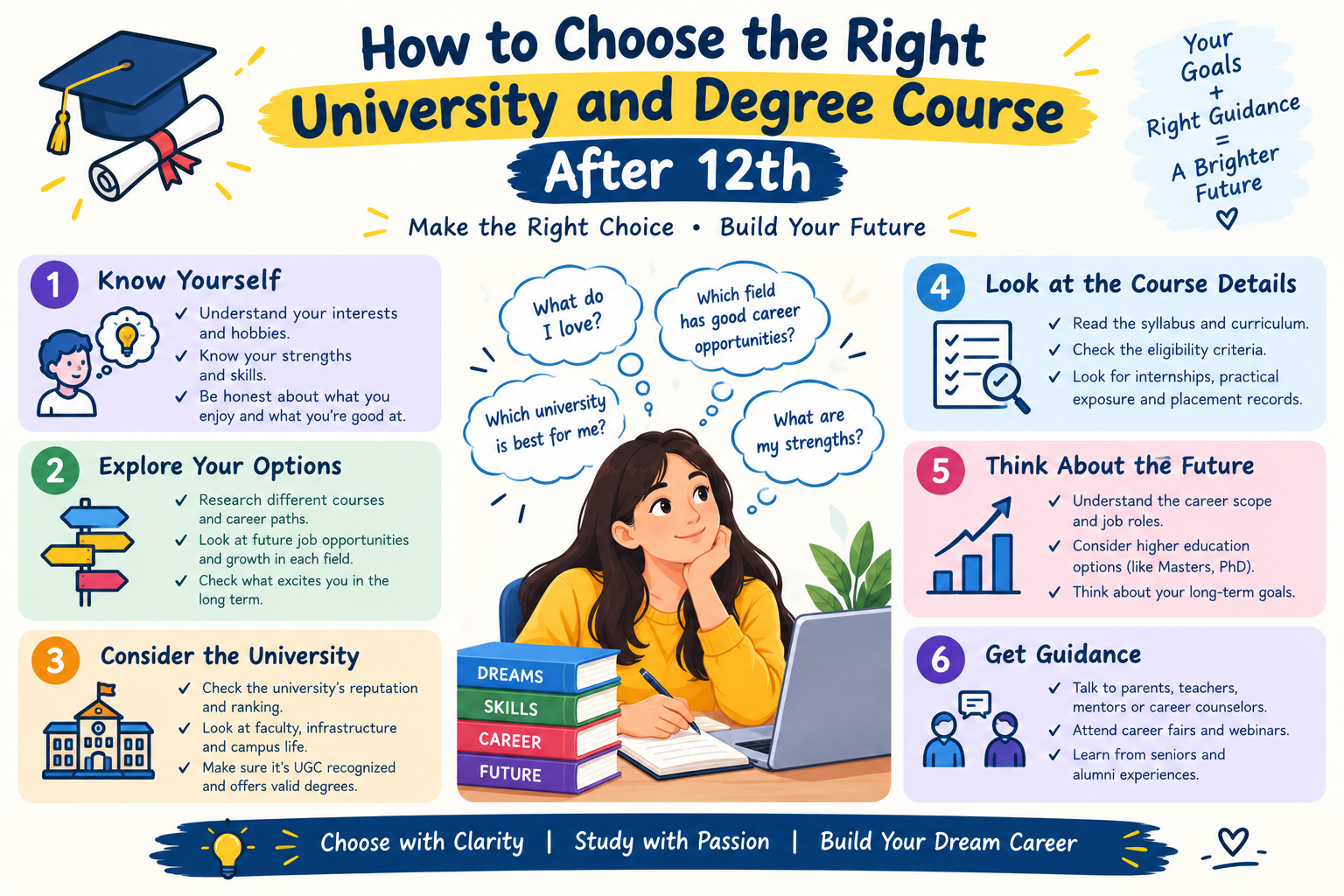
How to Choose the Right University and Degree Course After 12th
Completing Class 12 is an important milestone in every student's academic journey. It is also the time when students have to make one of their first major career decisions: Which degree course should I choose, and which university is right for me?
With hundreds of courses, universities, specializations, and career pathways available, making this decision can feel overwhelming. Choosing a university only because it is popular or selecting a course because your friends are doing it can lead to regrets later. The right choice should align with your interests, academic strengths, career aspirations, and financial plan.
Why Choosing the Right Degree After 12th Matters
Your undergraduate degree forms the intellectual and technical cornerstone of your professional life. A suitable degree helps you:
- Build solid academic concepts and practical problem-solving skills
- Qualify for high-growth corporate roles or competitive government exams
- Secure verified internships and industry training
- Establish a credible profile for higher education (Master's, MBA, MS)
- Develop workplace communication, teamwork, and personal confidence
Part 1: Choosing the Right Degree Course
Step 1: Understand Your Interests & Aptitude
Before looking at universities, assess yourself objectively. Ask yourself:
- Which subjects do I genuinely look forward to studying?
- Do I prefer working with numbers, code, people, written ideas, or artistic design?
- What kind of daily work environment would I thrive in 5 years from now?
Do not pick a program solely because someone claims it has a high starting package. Long-term career success requires curiosity and consistency in that domain.
Step 2: Align with Your Class 12 Stream
Science Stream
Options include B.Tech/B.E., BCA, B.Sc (IT/Data Science/Physics), B.Pharm, Biotechnology, and Mathematics.
Commerce Stream
Options include B.Com (Hons), BBA, Economics (Hons), Banking & Insurance, and Business Analytics.
Arts & Humanities
Options include BA (Psychology, English, Political Science), Journalism & Mass Comm, Design, and Social Sciences.
Step 3: Map Long-Term Career Pathways
Understand where your chosen degree leads before enrolling:
- BCA / B.Tech: Prepares you for software engineering, cloud computing, cybersecurity, or higher studies like MCA/M.Tech.
- BBA / B.Com: Leads into financial analysis, corporate banking, marketing, sales management, or an MBA.
- BA / Mass Comm: Opens pathways in content strategy, public relations, civil services, psychology, and public policy.
Step 4: Compare Your Top Course Options
| Evaluation Parameter | Course Option A | Course Option B | Course Option C |
|---|---|---|---|
| Primary Focus & Core Subjects | - | - | - |
| Practical Skills Developed | - | - | - |
| Course Duration | - | - | - |
| Eligibility & Entrance Requirements | - | - | - |
| Postgraduate Pathways (MBA / Master's) | - | - | - |
Part 2: Choosing the Right University (11 Essential Steps)
- 5 Verify Legal Recognition: In India, check official recognition on the University Grants Commission (UGC) portal, along with relevant statutory councils (such as AICTE, BCI, or PCI).
- 6 Scrutinize the Updated Syllabus: Check whether the university teaches modern industry-aligned subjects, hands-on lab projects, and contemporary software tools.
- 7 Check Faculty Profiles: Look for professors with proven industry experience, academic research, and active student mentorship track records.
- 8 Calculate the Full Financial Cost: Calculate total expenses—tuition, registration, examination charges, hostel, food, travel, and books. Ask about scholarship and installment schemes.
- 9 Inspect Learning Infrastructure: Verify that laboratories, computing centers, research libraries, and digital access portals meet the practical requirements of your field.
- 10 Evaluate Internship Policies: Practical exposure matters. Check whether the university has formalized corporate internship partnerships and real-world project credits.
- 11 Scrutinize Placement Statistics: Look beyond marketing claims of "100% Placements." Verify median salary figures, visiting hiring partners, and interview readiness bootcamps.
- 12 Evaluate Location & Campus Life: Proximity to industrial and IT corridors offers easier access to networking, workshops, guest lectures, and student societies.
- 13 Match with Your Learning Style: Decide whether you perform best in a structured physical campus or require the flexibility of a recognized online/distance program.
- 14 Check Specific Admission Deadlines: Confirm cutoffs, entrance exam weightages, counselling schedules, and list of required documentation.
- 15 Visit Campus or Connect with Alumni: Speak directly to current students and alumni on LinkedIn to get an unbiased review of academic rigor and hostel management.
Warning Against Misleading Claims: Never rely on promotional social media ads, unofficial counselling agents, or unverified placement numbers. Always verify accreditations directly from official regulatory portals.
Questions to Ask the Admissions Office Before Paying Fees
- Is this specific department and course approved by UGC and statutory councils?
- What is the itemized fee breakdown for all semesters, including re-exam and lab fees?
- What companies recruited from this exact department during the last academic session?
- What is the official admission withdrawal and fee refund policy?
- Are merit-based or need-based scholarships renewed every academic year?
Common Mistakes to Avoid
Key Takeaways: Avoid following peers blindly, overlooking statutory accreditations, assuming prestige applies equally across all departments, and signing admission documents without reviewing refund rules.
List of Private Universities to Research for Higher Education
Students exploring recognized undergraduate and postgraduate programs across regular, distance, or online options can research universities such as:
1. Subharti University
Known for diverse professional and higher education programs across disciplines.
2. Mangalayatan University
Offers professional undergraduate degrees with modern academic infrastructure.
3. Dr. Preeti Global University
Multi-disciplinary institution offering various skill-oriented academic programs.
4. Bir Tikendrajit University
Offers varied higher-education degrees. Check latest course-wise regulatory status.
5. Guru Kashi University
Provides diverse programs in engineering, management, commerce, and computer science.
6. Matrix Skilltech University
Focuses on skill-oriented curriculums designed to enhance employability.
7. Asian International University
Offers multiple degree tracks for students after Class 12.
8. NIILM University
Private institution providing higher education courses in management, law, and arts.
9. Sikkim Alpine University
Offers degree options across traditional and professional study streams.
Final Pre-Admission Checklist
Frequently Asked Questions
Both are important, but the course is foundational. A famous university cannot help you succeed in a field where you have no genuine interest or aptitude. Finalize the right course first, then find the best accredited university that fits your budget.
No. Initial salaries vary with market cycles, but genuine subject mastery, practical problem-solving skills, and consistency dictate your long-term career growth. Pick a domain where you can stay competitive over decades.
Visit the official University Grants Commission (UGC) portal (ugc.ac.in) and look up the consolidated list of recognized Central, State, Private, or Deemed universities. For distance or online courses, verify on the UGC-DEB portal.
Yes. Students from Science streams can switch to Commerce (B.Com, BBA) or Humanities (BA, Mass Comm, Law). Commerce and Arts students can pursue careers in management, design, digital marketing, law, and computer applications (BCA), depending on individual university criteria.
Speak with an Academic Advisor
Share your details and our counsellors will assist you with degree options, fees, and eligibility.