
MBA After B.Com: Eligibility, Benefits and Career Opportunities
A Bachelor of Commerce (B.Com) provides a strong grounding in core commerce, taxation, and financial fundamentals. However, to transition into corporate leadership, strategy, product consulting, and cross-functional management, an MBA is one of the most respected academic and career upgrades available.
Can You Do an MBA After B.Com?
Yes, absolutely. B.Com graduates are fully eligible for both general and specialized MBA programs across national and international universities. In fact, commerce graduates often have a competitive head start in quantitative modules over students from non-commerce backgrounds.
Key areas where B.Com students hold an initial edge:
- Financial Accounting & Managerial Costing
- Corporate Taxation and Auditing Principles
- Macro & Micro Economics
- Business Law & Financial Management
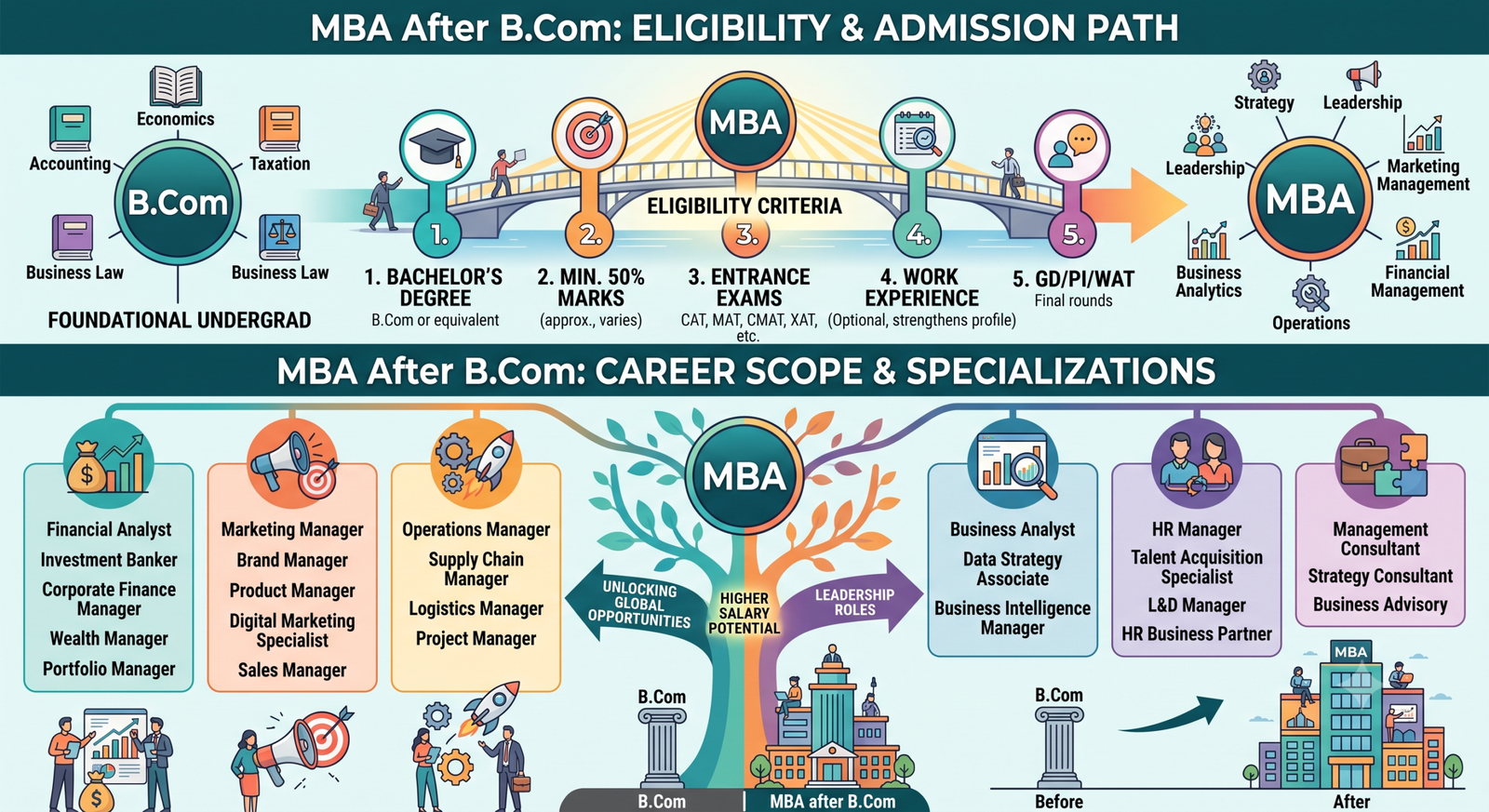
MBA After B.Com Eligibility Criteria
While specific cutoffs vary between institutions, the standard eligibility requirements include:
- Undergraduate Degree: A recognized B.Com (General, Honours, Accounting & Finance, etc.) from an accredited university.
- Minimum Marks: Typically 50% aggregate marks for General category students (45% for reserved categories).
- Entrance Exams: Valid scores in national or university tests (such as CAT, MAT, XAT, CMAT, ATMA) or merit-based eligibility where applicable.
Does your B.Com percentage matter? Yes. Top B-schools and tier-1 institutions consider graduation aggregate scores alongside entrance percentiles and personal interview rounds.
Is Mathematics Required for an MBA After B.Com?
Advanced higher mathematics in 12th or graduation is not mandatory for most MBA programs. However, students should be comfortable with basic quantitative aptitude, business statistics, data analytics, and corporate finance.
Why Choose an MBA After B.Com? (Top Benefits)
- Broader Strategic Perspective: Shifts your career focus from transactional bookkeeping to corporate decision-making and marketing strategy.
- Career Diversification: Enables you to pivot beyond accounting into product management, management consulting, brand strategy, and venture growth.
- Leadership & Soft Skills: Cultivates essential executive skills like stakeholder negotiation, team management, business communication, and cross-cultural leadership.
- Higher Career Ceiling: Opens corporate doors to roles like Management Trainee, Financial Analyst, and Department Head.
B.Com vs MBA: Quick Comparison
| Factor | B.Com (Undergraduate) | MBA (Postgraduate) |
|---|---|---|
| Focus | Commerce & Accounting basics | Strategic Management & Leadership |
| Program Level | Entry-level undergraduate | Advanced professional master's |
| Core Subjects | Tax, Auditing, Accounts, Law | Finance, Marketing, Analytics, HR, Ops |
| Career Trajectory | Operational & junior accounting roles | Mid-to-senior corporate management |
Best MBA Specializations for B.Com Graduates
Choosing the right specialization aligns your commerce background with future market demand:
1. MBA in Finance
The most natural continuation for B.Com students. Focuses on investment banking, portfolio management, corporate finance, and risk evaluation.
2. MBA in Business Analytics
Combines financial acumen with data tools like Excel, SQL, Tableau, and Power BI to drive evidence-based corporate strategies.
3. MBA in Marketing
Ideal for creative thinkers interested in consumer behavior, digital growth marketing, brand management, and market research.
4. MBA in Human Resources
Focuses on talent acquisition, performance systems, compensation structuring, and organizational culture development.
5. MBA in Operations & SCM
Covers process optimization, global supply chain networks, inventory analytics, and project coordination.
6. MBA in International Business
Prepares students for cross-border trade, foreign currency operations, multinational compliance, and global marketing.
Career Opportunities & In-Demand Job Roles
| Target Job Role | Relevant Specialization | Primary Function |
|---|---|---|
| Financial Analyst | Finance | Valuation, financial modeling & forecasting |
| Business Analyst | Business Analytics | Translating data patterns into growth insights |
| Marketing / Brand Manager | Marketing | Customer acquisition, branding & campaigns |
| HR Business Partner (HRBP) | Human Resources | Talent management & organizational strategy |
| Operations Executive | Operations / SCM | Supply chain optimization & vendor workflows |
| Relationship Manager | Finance / Marketing | Corporate banking & high-net-worth client accounts |
| Management Trainee (MT) | General Management | Fast-track corporate leadership across functions |
Online MBA vs Regular MBA: Which One Should You Pick?
| Factor | Online MBA | Regular (Campus) MBA |
|---|---|---|
| Learning Format | Digital LMS (Recorded & Live sessions) | Physical lecture halls & seminars |
| Schedule Flexibility | High (Ideal for working professionals) | Fixed daily college hours |
| Hostel & Commute | Zero living or relocation expenses | Mandatory daily commute or hostel stay |
| Networking Style | Virtual peer groups & digital forums | Direct face-to-face campus connections |
| Best Suited For | Working professionals & budget-conscious learners | Fresh graduates seeking full campus immersion |
Step-by-Step MBA Admission Roadmap
- 1 Identify Preferred Domain: Match your interests with Finance, Analytics, Marketing, or Operations.
- 2 Shortlist Verified Universities: Verify official regulatory recognition (e.g., UGC-DEB, AICTE).
- 3 Check Entry Requirements: Note cutoff criteria, entrance score requirements, or direct admission routes.
- 4 Assemble Documentation: Keep your 10th, 12th, and B.Com provisional marksheets ready with photo ID.
- 5 Complete Evaluation: Clear the university entrance, interview rounds, or merit evaluations.
- 6 Fee Confirmation: Finalize tuition installment plans and confirm enrolment.
High-Value Skills to Master Alongside Your MBA
- Data & Analytical Tools: Advanced Microsoft Excel, Power BI, SQL, and basic Tableau.
- Executive Communication: Clear professional writing, stakeholder presentations, and active listening.
- Digital Marketing & Growth: Fundamentals of SEO, Google Ads, CRM platforms, and performance analytics.
- Strategic Problem-Solving: Business case study evaluation and scenario forecasting.
Common Pitfalls to Avoid: Never pick a specialization solely based on rumors of the "highest starting package." Select a domain where your natural aptitude matches market growth, and always verify university accreditation before depositing fees.
Partner Institutions & Academic Pathways
Students looking for recognized distance, online, and regular higher-education degrees often explore options across recognized universities, including:
- Swami Vivekanand Subharti University
- Mangalayatan University
- Dr. Preeti Global University
- Bir Tikendrajit University
- Guru Kashi University
- Asian International University
- NIILM University
- Sikkim Alpine University
Gyan Institute of Higher Studies (GIHS) provides admission counseling, university comparison support, and documentation guidance to help students select the right program for their career goals.
Frequently Asked Questions
Yes. B.Com General, B.Com Honours, and vocational commerce graduates are all eligible for MBA admission, provided they meet the minimum aggregate marks required by the university.
MBA in Finance and MBA in Business Analytics are popular options due to the background in accounting and economics. However, Marketing, HR, and Operations are equally suitable depending on your career interests.
If your career goals are clear, joining right after B.Com helps maintain academic continuity. If you are undecided about your specialization, working for 1–2 years provides valuable workplace context before starting an MBA.
Yes, provided the program is pursued from a university recognized by regulatory bodies like UGC and UGC-DEB in India. It holds parity with regular degrees for corporate hiring and competitive exams.
An M.Com is primarily academic and specialized in accounting, economics, and taxation—ideal for teaching, civil services, or specialized research. An MBA focuses broadly on corporate leadership, cross-functional operations, and strategic business management.